Wednesday, July 22, 2020

How To Use Your Singing Bowl Every Day

At Silent Mind, there’s always a singing bowl playing, whether we’re testing out a new design, or taking a wellness break. Still, we realize that for some of our customers, using a singing bowl regularly is a new concept.
We believe that singing bowls are one of the most rewarding, powerful tools you can keep on hand. That’s why we’d like to share some of our favorite ways to use them daily.
This way, you’ll get the most value out of your singing bowl. Eventually, you might notice you’re getting more than you dreamed possible.
Meditation
Many new friends come to us looking to deepen their meditation practice. Like us, they’ve been captivated by the research asserting that meditation is an effective way to cope with stress.
Even if you only meditate for a few minutes daily, open and close your sitting with a few strikes of the bowl. If you have trouble quieting the mind, try a sound meditation instead.
Begin as you normally would in terms of posture and setting, but play your singing bowl throughout the sitting. Whether you’re striking or playing around the rim, focus on the sound and vibration, especially as it ebbs and flows under your direction.
Bedtime
Historically, singing bowls have been used to mark a transition in a ritual or practice. Today, we hear from grateful teachers all over the world who use our singing bowls in their classrooms to accomplish something quite similar.
Singing bowls are ideal for gently heralding anyone into a different activity or state of mind. You may not be a teacher, but you can use singing bowls every evening to mindfully transition your children into bedtime mode.
Yes, it works for adults, too. Sleep is our body’s time to rest and heal. There’s no better way to send your body the message that it’s time to settle in than with the sound of a singing bowl.
Inspiration
Getting stuck or feeling at a loss for what to do are common human experiences. Often, all we need is to take a step back and clear the mind. In these moments, the best course of action can present itself.
Singing bowls are an excellent way to get focused. The sound and vibration cancel out more chaotic frequencies that can cloud our judgment.

Monday, July 20, 2020

Tibetan Singing Bowls: What and How to Play Singing Bowls in Tibetan Buddhism

Tibetan music bowls, often called “singing bowls”, are a kind of bell used in Tibetan Buddhist meditation. Instead of hanging upside down and being struck, the bowl sits upright, and a wooden puja stick is used to vibrate the rim of the bowl, making its unique “singing” sound.
These bowls have been used in Tibetan Buddhism for centuries, and are an integral part of learning the Buddhist teachings as well as being used in meditation to attain enlightenment.
Origin and History
The origin of the singing bowls is lost in the mists of time. There are many debates on where they first came from, and many say that bowls made of the same materials came from ancient Mesopotamia. Similar bowls made from the same seven metals that have been unearthed in Persia (now Iraq) have been dated to be as old as 3,000 BC. However, since there are no written records of their origins, one can only speculate on the mystery of their beginnings. Some say that the great master, Padmasambhava, brought them to Tibet from India in around 800 AD. What is known is that the bowls could not have originated in Tibet, since the precious metals that are used in the making of the bowls are not found in the region.
One thing that is known is that the bowls have been made in Nepal for over a thousand years, with Nepali artisans hammering the seven metals into one alloy by hand, and shaping them into the bowls that are seen in the monasteries of Tibet. Therefore, the name Tibetan Singing Bowls does not denote the makers but are named for the peoples who used them. However, while the bowls are definitely Himalayan made, they were never Himalayan in origin, and this technology came to the Himalayas very late in Tibet’s history.
Making of Tibetan Singing Bowls
Tibetan singing bowls have been made the same way for centuries, but the art has since been lost during the move to more modern methods. Bowls are made more these days by machines, although they fail to get the perfect tone that the hand-made bowls achieve. Traditionally, the bowls were made by hand, hammering out their shape from sheets of metal alloy. Bowls that are more modern are mostly made from a kind of bronze alloy known as “bell metal”, which is a mix of copper and tin. However, traditionally, the bowls were made from very high-quality bronze, with a mix of other metals. This unique alloy also contained gold, silver, mercury, lead, and meteorite iron. This iron, which is known as thogcha, or “sky metal” in Tibet, was highly prized for its pure iron content, with minimal amounts of trace elements. This could only be obtained by meteorite iron, as the atmospheric burn-off removed many of the impurities in the ore.
The quality and composition of the bowls, using multiple metals in the alloy, is thought to be the reason for the high quality of sounds from the antique bowls. Combined with age and design, these three elements are what make the antique bowls so sought-after in the modern market. While modern bowls can produce beautiful sounds, they cannot compare with the unique quality of the antique bowls.

Tibetan Singing Bowl Meditation gift

According to Tibetan oral tradition, the existence of singing bowls dates back to the time of the historical Buddha Shakyamuni (560 – 480 B.C.) The tradition was brought from India to Tibet, along with the teachings of the Buddha, by the great tantric master Padmasambhava in the 8th century A.D.
Singing bowls produce sounds that invoke a deep state of relaxation which naturally assists one in entering into meditation, the ultimate goal being enlightenment. They are a quintessential aid to meditation and can be found on private Buddhist altars, and in temples, monasteries and meditation halls throughout the world.
Spiral Singing Bowl Meditation Gift Box Set- 4″
Metallurgical analysis of bowls vary, from a predominantly two metal alloy of copper and tin with trace iron content to an eight alloy of copper and tin with traces of iron, lead, zinc, gold, silver, and mercury.
In addition to their traditional usage for meditation, Tibetan singing bowls are used for deep relaxation, stress reduction, holistic healing, Reiki, chakra balancing, and World music. Many people find that the rich blend of harmonic overtones that the bowls produce has a direct effect on their chakras.
Playing the bowl usually causes an immediate centering effect. The tones set up a “frequency following response” that creates a balancing left/right brain synchronization. Meditating on the subtle sounds of the Tibetan singing bowl tunes one in to the universal sound within and without.
Previously used in Tibet for meditation and ceremonial purposes, Tibetan Singing Bowls are struck with a mallet or rubbed around the rim to produce a fascinating blend of harmonic resonance and rich overtones. Generally, smaller diameter Singing Bowls have higher tones, while the larger bowls produce a wider dynamic range of sound with rich deeper Om tones.
Peace Singing Bowl Meditation Gift Box with Pillow
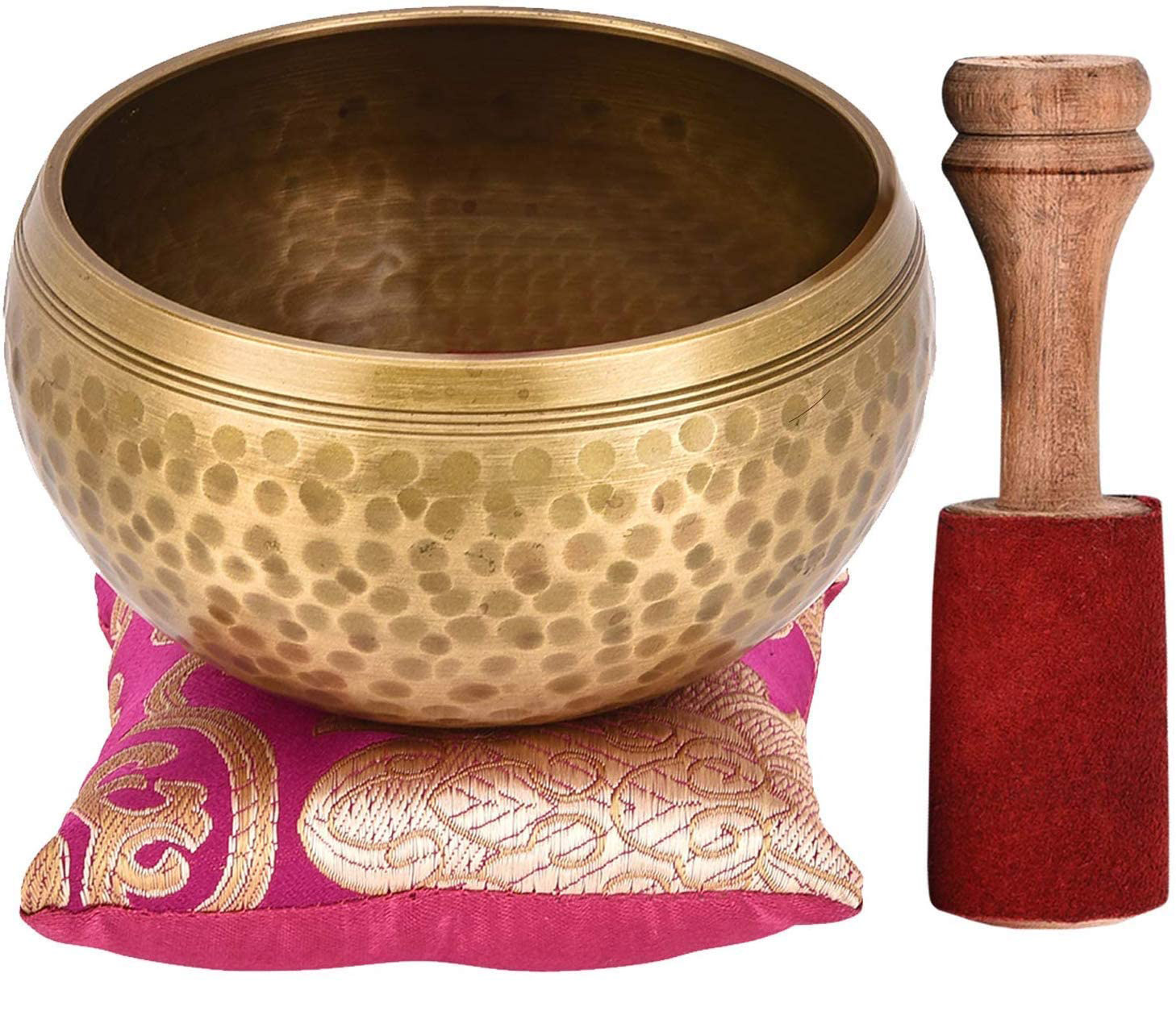
Our Tibetan Singing Bowls come in sizes from our mini bowls at 2 inches in diameter to larger bowls 11 inches in diameter. Each Tibetan Singing Bowl comes with a wooden mallet. Many come with their own Singing Bowl Cushions typically made of silk-brocade and cotton. But if not, we also have cushions available and sold separately in many colors and sizes. Many of our bowls are sold in beautiful lotus paper boxes making them perfect for gift giving.

Friday, July 17, 2020

Singing Bowl Mallet Meditation

Every singing bowl sound sample recorded on our web site has been played with the following variety of mallets. Tibetan Singing bowls can sound completely different whether they are struck with wool, leather, or wood; and you can isolate completely different tones depending upon the mallet and the playing technique you use. All of the mallets produce different sounds from the bowls and learning which ones to use with which bowls- and how to use them- is an ongoing discovery.
Back in the late ’70s’ in Kathmandu, we know the Nepalese played singing bowls with Roti sticks. Historically, any plain wood dowel may have been used. But the harsh sound created by the wood striking the metal also had the effect of sharply kicking up the female overtone and hence burying the deeper, more subtle sound of the fundamental tone. Hence, the wool padded mallet!
WOOL PADDED MALLET
This wooden mallet, semi-padded with monk’s wool, softens the struck sound of a singing bowl. A Bodhisattva basic, the padded mallet is designed to bring all of the bowls’ frequencies up to at equal volume. We played with different thicknesses of the dowel, which is made of Sheesham, a Himalayan hardwood. In time, we found if the dowels were roughly 30 mm. thick, that was about right for producing a balanced struck tone in most medium-sized singing bowls and even some of the Highwalls as well. This type of mallet produces most of the bowl strikes you hear in the recordings on our web site. The wooden handle provides a rimming surface as well.
HOW TO USE IT FOR STRIKING
Using the wool padded end, strike the Tibetan singing bowl on its mid-exterior wall, or on the interior upper wall. Acoustically, upper octave tones carry louder than deeper tones, due to their increased saturation of sound waves. So when we strike a singing bowl with a padded mallet, we hear the richness of the fundamental tone much more clearly in the mix. Avoid striking the bowl on the top of the lip, as this will produce too much of a percussive hit.
HOW TO USE IT FOR RIMMING
  1. Sit as if you were sitting for meditation, with your spine straight and relaxed, your shoulders level and your breath generous but natural. Make sure to release any unnecessary tension in your arms, shoulders, and face, as Tibetan singing bowls are bio-feedback instruments and they tend to be really quiet when we’re holding tension in our bodies.
  2. Hold the singing bowl on the palm of your non-dominant hand, with your fingers energized and held closely together. This is important so that your fingers and thumb do not involuntarily wrap around the base of the bowl while playing, which will dampen the sound. Hold the bowl about Solar Plexus level, slightly tilted so that the aperture of the bowl is opening into the direction where your mallet is coming from.
  3. With your dominant hand, grasp the mallet in its center and hold it as if you were about to sign your name with the wooden end of the mallet. Make sure the covered part of the mallet is snuggled securely in the web between the thumb and the index finger, and that there is never any gap there while playing. So your grasp on the mallet should be firm but never strained.
  4. Position the mallet at a 35% angle against the outside edge of the lip of the bowl. With an even pressure, rub the mallet in at least 4 or 5 revolutions, or until you begin to hear the female overtone build. Use a full arm motion, like you’re stirring a pot of soup. Try to keep your wrist as straight as possible.
  5. Once the female overtone starts to comes up bright and clear, reduce your speed and press a little bit more firmly. If you hear “chattering” against the lip of the bowl, either reduce your speed, even more, increase your pressure, or both. Watch the bowl as you continue to rub the rim, and listen to the bowl’s voice. Adjust your angle, pressure, and speed accordingly. When you bring it all together, the female overtone should sound sweet and clear.
Although it is tempting to close your eyes when first starting to play, I find that it’s helpful at least in the beginning to keep them open and to observe what you’re doing carefully. This practice also gives the focus necessary to clear the mind. If there is chatter on the inside lap of the circle, check to see if your angle and speed are consistent all 360 degrees. Once the tone is even and smooth and you’re really connected to the bowl- then close them if you like.

Thursday, July 16, 2020

Tibetan Singing Bowl Mallet Meditation

A very simple and elegant tool for meditation and creating space for yoga and awareness is the singing bowl. Children are naturally are drawn to instruments and can be guided into focused attention when sounding them provided that they are shown how to hold the bowls with reverence and care.
You can get a singing bowl at any Tibetan store or online for a wide range of prices. It’s a good idea to try a number of different bowls to get a feeling for the sound you like the best.
Begin by sitting up tall in a cross-legged seat with your singing bowl resting in the open palm of one hand and your mallet held relaxed on the other hand. Invite the sound of the bowl by circling the mallet around the outside the bowl until the sound has grown as loud as you enjoy. As soon as the bowl is sounding on its own without the mallet, begin counting your breaths.
One breath is comprised of one inhale plus the exhale. Count how many times you can do a complete breath cycle before you can no longer hear the bowl. You might notice you get distracted. Just notice and see how many breaths you can count before you lose track. Notice if you find yourself amused, annoyed, distracted, or soothed. Notice and let it go.
An even simpler meditation that I like to do at the beginning of class is to direct the children to sit up tall with the backs of their hands resting on their knees. When they are focused on me with still bodies and quiet mouths, I tell them to rest their eyes so that their ears can listen for the sound of the Tibetan singing bowl growing, then fading. “See if you can catch the moment when the sound disappears.” This simple technique can be used with even toddlers, as there is something very compelling about the bowl sounding.
There are countless ways the singing bowl can be used to create a meditative space with your children. One of my favorites is to use it as a tool to bring the family to a moment of shared silence when voices begin to rise in conflict. Do you use the singing bowl in your home? Please share your singing bowl experience in the comment space below.

Wednesday, July 15, 2020

Effects of Singing Bowl Sound Meditation on Mood, Tension

Poor mood and elevated anxiety are linked to increased incidence of disease. This study examined the effects of sound meditation, specifically Tibetan singing bowl meditation, on mood, anxiety, pain, and spiritual well-being. Sixty-two women and men (mean age 49.7 years) participated. As compared with pre-meditation, following the sound meditation participants reported significantly less tension, anger, fatigue, and depressed mood (all Ps <.001). Additionally, participants who were previously naïve to this type of meditation experienced a significantly greater reduction in tension compared with participants experienced in this meditation (P < .001). The feeling of spiritual well-being significantly increased across all participants (P < .001). Tibetan singing bowl meditation may be a feasible low-cost low technology intervention for reducing feelings of tension, anxiety, and depression, and increasing spiritual well-being. This meditation type may be especially useful in decreasing tension in individuals who have not previously practiced this form of meditation.
Heart disease, diabetes, addiction, and mental health issues have all been linked to stress and tension. Meditation, including systems such as mindfulness-based meditations, has shown promise in inducing the relaxation response and helping alleviate anxiety and improve well-being. The relaxation response is the body’s physiological response in relaxation, including lowered blood pressure to counter the fight-or-flight response and activation of the parasympathetic nervous system. As promising as mindfulness and other meditation systems may be, a common complaint is time, patience, and discipline required to learn meditation. Thus, a form of relaxation and stress relief that does not require a steep learning curve or a great deal of discipline to utilize could potentially be a huge benefit to human wellness and health.
The authors set out to examine the possibility that merely lying down and listening to the high-intensity, low-frequency combination of singing bowls, gongs, and bells in a sound meditation could induce a deep relaxation response and positively affect mood and sense of well-being. Sound healing has been used for centuries and been utilized in various forms by cultures the world over, including native peoples. Australian aboriginal tribes have used the didgeridoo as a sound healing instrument for over 40,000 years. Ancient instruments have also been used for religious and spiritual ceremonies such as Tibetan (also called “Himalayan”) singing bowls. Tibetan singing bowls are metal bowls usually consisting of a combination of metal alloys and originally used by Tibetan monks for spiritual ceremonies.
While sound healing is not a new concept, there is a paucity of research in areas such as Tibetan singing bowls. The majority of singing bowl studies relate to the physics of these musical instruments, including the sonic and wave properties, as well as attempting to model the singing bowl’s acoustic characteristics. In one study, singing bowls were used for emotional healing with high-risk youth as part of what was termed the best self-visualization method. The bowls were used in a psychotherapy model in combination with deep breathing, visualization, and loving-kindness meditation. The authors reported that this combination of healing methods may be a catalyst for emotional and psychological healing in counseling sessions.
The purpose of the present study was to further advance research in this area by examining the possible effects of singing bowls and sound healing on mood, anxiety, physical pain, and spiritual well-being, and to lay the foundation for a future more formal randomized control trial.

Tuesday, July 14, 2020

How Tibetan Singing Bowls Affect Our Body?

Sound therapy with Tibetan singing bowls is an ancient form of regeneration. The first bowls were made from an alloy of various metals and were used already 6000 years ago in the Far East. Tibetan singing bowls area a mysterious acoustic phenomenon, which was discovered by “spiritual tourists” in the Himalayas and after the Chinese invasion of Tibet appeared also in Europe and the USA.
The sound of Tibetan singing bowls and the gong harmonizes and allows deep relaxation of both sides of the brain. It stimulates stress relief on all levels and the elimination of toxins from the body. After sound therapy emotions are calm and the mind clearer and the sound vibrations have an effect on the body after the singing bowls have been played on it.
After sound therapy we are tuned again …
The bowl sings ”ommmmm”, which revives the basic DNA codes and activates the codes that we haven’t yet perceived or we had suppressed till now. Tibetan singing bowls are one of the strongest musical instruments for healing with sound therapy and vibrations. They are called singing bowls because their exotic sound continues to float for a long time after we have played on them.
Why are these bowls so special?
Tibetan bowls are forged with alloys that usually contain from five to seven precious metals, which are connected to the planets of our galaxy: lead (Saturn), tin (Jupiter), iron (Mars), copper (Venus), mercury (Mercury), silver (the Moon) and gold (the Sun). The size of the bowl and the ratio between the metals affect the tone, vibration, and quality of sound produced by the bowl. Bowls vary in shapes and look as they are used for sound therapy in different ways and with different accessories. The most commonly used accessory is the so-called “strikers”, which are used to strike to bowls or wooden mallets that are rotated around the rim of the bowl. Besides Tibetan bowls, there are also Nepalese, Japanese, Bengalese and crystal bowls – the latter is made out of glass.
How does sound affect our body?
The sound is undoubtedly one of the most powerful media, as it can take the human spirit in different states of consciousness.
Besides their traditional use for meditation, Tibetan singing bowls are used for deep relaxation and muscle regeneration, to relieve pain in the joints, muscles, and shoulders, to ease pain related to sciatica, the digestive system, headaches, and migraine or spine injuries, to improve circulation, release tensions or blockages, to open the energy flow, eliminate the toxins from the body. When we relax with the sounds of Tibetan bowls or the gong, our concentration improves and our emotional tensions and blockages are eased. The sound with its vibrations can ease mental or emotional pain (low self-esteem, worries, fear, anger, anxiety, depression, insomnia). Tibetan singing bowls and their unique tones are used to stabilize blood pressure, to ease asthma-related issues, to renew the functioning of the adrenal gland, to open and stabilize the meridians, and to improve the synaptic responses in our brain. They also help children with hyperactive disorders and they stimulate the immune system.